The phrase turn off meaning in relationship is commonly searched by people trying to understand why attraction suddenly fades or why certain behaviors push a partner away.
In dating and long-term partnerships, small habits, attitudes, or actions can deeply influence emotional and physical connection. When someone says, That’s a turn off they are expressing a loss of interest, excitement, or attraction triggered by something specific.
People look up this term because relationships can feel confusing. One moment everything seems perfect, and the next, chemistry shifts.
Understanding what causes this reaction helps individuals improve communication, avoid misunderstandings, and strengthen bonds.
Whether in early dating stages or committed relationships, recognizing what diminishes attraction is essential for building healthier, more satisfying connections.
Definition & Meaning
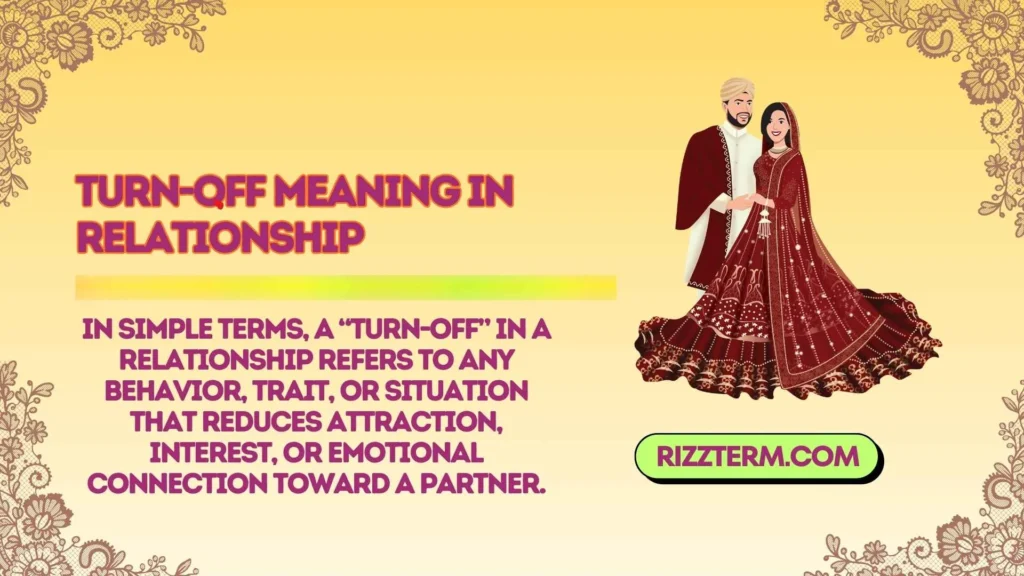
In simple terms, a “turn-off” in a relationship refers to any behavior, trait, or situation that reduces attraction, interest, or emotional connection toward a partner. It can be physical, emotional, intellectual, or behavioral.
Turn-offs vary from person to person. For some, dishonesty or lack of ambition might instantly lower attraction. For others, poor communication, disrespect, or negative attitudes may trigger emotional distance. The key element is the shift in perception — something that once felt appealing now feels uncomfortable or unattractive.
Turn-offs can be:
- Behavioral: Arrogance, constant criticism, laziness
- Emotional: Jealousy, manipulation, lack of empathy
- Physical: Poor hygiene, neglect of self-care
- Value-based: Conflicting morals or long-term goals
Importantly, a turn-off does not always mean the relationship is over. It simply signals discomfort or dissatisfaction that may need attention. Healthy relationships often involve discussing these issues openly instead of ignoring them.
Background & History
The concept of being “turned off” has existed for centuries, though the phrase itself became popular in modern English during the 20th century. Originally, “turn off” referred to switching off a device or light. Over time, it evolved metaphorically to describe shutting down emotional or physical attraction.
As dating culture shifted in the late 1900s, especially with the rise of modern psychology and relationship studies, the language around attraction became more detailed. Terms like “chemistry,” “red flags,” and “deal-breakers” emerged alongside “turn-offs.”
In earlier generations, people were less open about discussing emotional preferences. Today, with social media and online dating, individuals openly talk about what excites them and what immediately kills attraction. This cultural shift has made the phrase more common and widely understood.
Usage in Various Contexts
The phrase appears in many different relationship scenarios:
1. Early Dating
Someone might say, “Rudeness is a turn-off,” meaning they quickly lose interest if their date behaves disrespectfully.
2. Long-Term Relationships
A partner might feel emotionally turned off by neglect, lack of appreciation, or ongoing conflict.
3. Physical Attraction
Certain habits, poor hygiene, or lack of effort can reduce physical chemistry.
4. Emotional Connection
Dismissive behavior or emotional unavailability can create distance and weaken intimacy.
The meaning shifts slightly depending on tone. Sometimes it is lighthearted. Other times, it signals deeper dissatisfaction. Understanding context is crucial.
Common Misconceptions & Clarifications
Many people misunderstand what a turn-off truly means. Let’s clarify:
Misconception 1: A turn-off always means breakup.
Not true. It often indicates discomfort that can be resolved through communication.
Misconception 2: Turn-offs are always superficial.
Some are surface-level, but many relate to values, emotional maturity, or compatibility.
Misconception 3: Only one partner has turn-offs.
Every individual has preferences and boundaries.
Misconception 4: Expressing turn-offs is rude.
When communicated respectfully, sharing concerns strengthens relationships.
Understanding these clarifications helps avoid unnecessary panic and encourages constructive dialogue.
Similar Terms & Alternatives
Several phrases are closely related:
- Deal-breaker – A non-negotiable issue that ends a relationship.
- Red flag – A warning sign of potential serious problems.
- Ick – A sudden feeling of disgust or loss of attraction.
- Turn-on – The opposite; something that increases attraction.
While similar, these terms are not identical. A deal-breaker is usually permanent. A turn-off can sometimes be temporary or fixable.
How to Respond to This Term
If someone tells you that something is a turn-off, avoid reacting defensively. Instead:
- Listen calmly.
- Ask for clarification.
- Reflect honestly.
- Decide whether adjustment feels reasonable.
Healthy response example:
“I didn’t realize that bothered you. Can you explain more?”
Unhealthy response example:
“You’re too sensitive.”
Constructive communication turns potential conflict into growth. Not all feedback requires change, but understanding your partner’s perspective builds trust.
Regional or Cultural Differences
Cultural values strongly influence what people consider a turn-off.
In conservative cultures, public displays of affection may be seen negatively. In more liberal societies, emotional unavailability might be viewed as a bigger issue. Gender roles, communication styles, and expectations also shape perceptions.
For example, in some cultures, financial stability is highly valued, so irresponsibility may quickly reduce attraction. In others, independence and ambition matter more.
Understanding cultural context prevents unfair judgment and promotes empathy.
Comparison with Similar Terms
It helps to compare related concepts:
| Term | Meaning | Severity |
|---|---|---|
| Turn-off | Reduces attraction | Mild to moderate |
| Ick | Sudden disgust | Usually emotional |
| Red flag | Warning of danger | Serious |
| Deal-breaker | Ends relationship | Final |
A turn-off may become a deal-breaker if repeated or ignored. However, not every turn-off signals serious incompatibility.
Usage in Online Communities & Dating Apps
On dating apps and social media, people openly list their turn-offs in bios or posts. Examples include:
- “Biggest turn-off: dishonesty.”
- “Negativity is an instant turn-off.”
In online discussions, the term is often used casually. Memes and viral trends have also popularized the concept of “the ick,” closely related to turn-offs.
Digital culture encourages people to define boundaries clearly. While helpful, this sometimes leads to unrealistic expectations or overly rigid standards.
Hidden or Offensive Meanings
Occasionally, the term can carry subtle criticism. Calling someone a “turn-off” may hurt their confidence if expressed harshly.
In some cases, it can reflect shallow judgments based on appearance or social status. This becomes problematic when it promotes discrimination or unrealistic beauty standards.
Therefore, sensitivity matters. Expressing discomfort about behavior is different from insulting someone’s identity.
Suitability for Professional Communication
In professional settings, using the phrase casually may sound informal or inappropriate.
For example, saying “That presentation was a turn-off” in a workplace meeting could seem unprofessional. Instead, phrases like:
- “That approach may reduce engagement.”
- “This might negatively impact perception.”
Clear, respectful language works better in formal environments. The term fits best in personal or social discussions rather than corporate communication.
FAQs:
What does turn-off mean emotionally?
It describes a loss of emotional attraction caused by behavior or attitude.
Is a turn-off the same as a deal-breaker?
No. A deal-breaker usually ends relationships permanently.
Can turn-offs change over time?
Yes. Personal growth and maturity can shift preferences.
Are turn-offs always negative traits?
Not always. Sometimes they reflect simple incompatibility.
Should I tell my partner about a turn-off?
Yes, if expressed respectfully and constructively.
Can small habits become major turn-offs?
Yes, especially if repeated without discussion.
Conclusion:
Understanding the turn off meaning in relationship helps individuals navigate attraction, communication, and compatibility more effectively.
A turn-off does not automatically signal failure; instead, it highlights areas needing attention or discussion.
By recognizing personal boundaries and respecting differences, couples can strengthen trust and emotional intimacy
. Healthy communication transforms potential disconnection into an opportunity for growth. Ultimately, awareness and empathy are key to maintaining lasting, meaningful relationships.

Hi, I’m Mark Jacob, the writer behind Rizzterm — where confidence meets clever conversation. I craft smooth rizz lines, playful wordplay, and charm-packed phrases that make talking easier and flirting more fun. My goal is simple: turn everyday words into instant vibe and connection. If it sparks a smile, it’s Rizzterm ready.